
Claude MCP Integration: conversational AI to enhance tactical analysis with Kognia
Updated: Sep 3
Football clubs have never had access to more data than they do today. Every match generates thousands of events, tracking points, tactical actions and performance metrics, offering unprecedented opportunities to understand players, teams and playing styles.
Yet, despite the abundance of information, accessing meaningful insights often remains a slow and technical process. Coaches, scouts and sporting directors frequently rely on analysts to answer ad-hoc questions, with teams often limited by predefined dashboards and reports. Valuable insights exist, but they are not always easy to reach.

Kognia’s Claude MCP Integration changes that experience entirely.
By combining Kognia's Semantic Layer with Model Context Protocol (MCP), football professionals can interact with their Kognia dataset using natural language. Instead of navigating dashboards or writing SQL queries, they simply ask a question and receive an accurate, contextual answer in seconds.

Rather than replacing existing analytical tools, the integration extends them, making football intelligence more accessible, more flexible and available through conversation.
The Foundation: Kognia's Semantic Layer
Large Language Models are exceptionally good at understanding natural language, but they do not inherently understand how a football database is organised. They cannot know which tables contain tactical events, how a KPI is calculated, or which metrics should always be interpreted together.
This is where Kognia's Semantic Layer becomes essential.
Sitting between the raw database and Claude, the Semantic Layer transforms technical data structures into meaningful football concepts. Instead of exposing database tables, columns and relationships, it provides a curated layer of trusted football definitions such as unmarking movements behind the defensive line, high-intensity actions, pressure on the ball possessor, defensive recoveries and player performance KPIs.
More importantly, every metric has a single definition.
Whether data is accessed through SQL, Tableau, the Kognia web application or Claude itself, the underlying calculation remains exactly the same. The Semantic Layer acts as the organisation's single source of truth, ensuring consistency, reliability and confidence in every answer.
This allows Claude to reason about football rather than databases.
Why MCP?
The MCP provides the bridge between Claude and Kognia's Semantic Layer.
Instead of relying on static prompts or manually uploaded datasets, Claude can securely access Kognia's structured tactical database in real time. Every question is translated into the appropriate query against the Semantic Layer, allowing Claude to retrieve accurate information while preserving the consistency of Kognia's data.
The result is an experience that feels less like querying a database and more like having a conversation with an experienced football analyst.
Ask football questions
One of the biggest advantages of the integration is its simplicity. Users no longer need to understand database schemas, metric names or filtering logic. They simply ask the question they want answered.
For example:
“Show me the U23 left full-backs who attack space well, how that translates into a penalty-box threat, and how much space they get from the nearest defender the moment they enter the box.”
Claude understands the football terminology, interprets the user's intent, queries the Semantic Layer and delivers an immediate answer. Detailed analysis using Kognia tactical data become accessible not only to analysts who can bring technical skills, but now also to coaches, scouts and sporting directors.

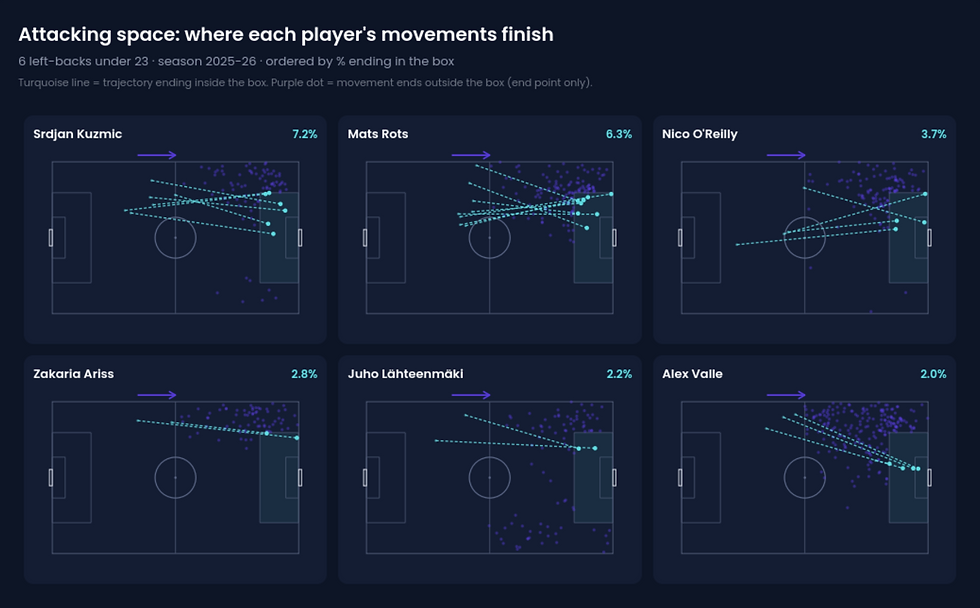
Explore data beyond traditional dashboards
Dashboards are excellent at answering predefined questions. However, football analysis is rarely predefined. The Claude MCP Integration removes those limitations by allowing users to explore data dynamically. Instead of waiting for a new dashboard or report to be built, users can combine competitions, tactical situations, match contexts, time periods and player profiles simply by asking.
Even better, every answer becomes the starting point for the next question.
A conversation might begin with:
“Show me which winger creates the most off-ball threat, combining how often they occupy dangerous space inside the box with their total volume of off-ball movements and size each point by how marked they are when they get there.”

And naturally continue with:
Only in LaLiga.
Under 23 years old.
During the second half.

Analyse performance in context
Football performance is highly contextual. A player's behaviour changes depending on the opponent, the score, the tactical system or the phase of the match. Looking only at season averages rarely tells the full story.
The Semantic Layer allows Claude to analyse performance across multiple contextual dimensions simultaneously, including match state, competition, tactical phase, time period, player, team and season.
Rather than presenting isolated statistics, the integration helps users understand performance within the context in which it actually happened.
Firstly, “show me which LaLiga strikers press the most and recover the ball most effectively while their team is trailing.”

Secondly, “show me the average ball recovery position for LaLiga strikers on a pitch map, sized by recovery volume, highlighting whoever combines the highest recovery height, pressing volume, and recovery volume; not just wherever the dot happens to land.”

Finally, “for the top 3 strikers by that merit score, show their second-half pressure heat maps side by side, and overlay their actual recovery locations as distinct purple dots. I want to see where they press versus where that pressure actually turns into a recovery.”

Into the detail with Dani Olmo

What makes this example different is scale: instead of a league-wide average, this is one player, one match, event by event. Thanks to Kognia's tracking data exposed through the MCP connector, Claude can reconstruct not just that Dani Olmo received the ball between the lines seven times against Valencia, but where his run started, how fast the pass arrived, how fast he was moving into the space, and how much room he had from the nearest defender when the ball reached him.
A season aggregate like "13.23 receptions per 90" is useful for scouting and benchmarking, but it flattens ninety minutes of very different situations into a single number. The moment you ask to see one match instead, the picture becomes concrete: reception two was a 20.5m first-time ball arriving at 58 km/h with a defender a metre away; reception three, a few minutes later, gave him over five metres of space. Two receptions, same player, same tactic label and completely different situations on the pitch.
Self-service football intelligence
Instead of relying on analysts for every ad-hoc request, football professionals can answer many questions independently.
Scouts can search for players matching specific tactical profiles. Coaches can investigate tactical behaviours before training sessions. Performance analysts can explore contextual metrics in seconds.
The result is a faster, more collaborative workflow where football intelligence is available to everyone.

To illustrate this in practice, we ran a query using the centre-back defensive-line variable and its compactness: "For two centre-backs from the same team playing genuinely opposite sides (one left-footed, one right-footed), for example, Deportivo Alavés's Jon Pacheco and Nahuel Tenaglia show me their pressure heat maps and their average ball recovery position on the pitch. Add a cross at each recovery point sized by how compact their defensive line is in depth and width.”


This is exactly the kind of question that would normally require a bespoke query or a purpose-built dashboard. Here, it took one sentence and returned the underlying data available for immediate follow-up, whether that means splitting by opponent, by game state, or cross-referencing against goals conceded in behind.
To find out more about how Kognia data can be integrated within your club's workflows and AI technology, please email: info@kogniasports.com
Integración de Claude MCP: IA conversacional para potenciar el análisis táctico con Kognia
Los clubes de fútbol nunca han tenido acceso a tanta información como hoy. Cada partido genera miles de eventos, puntos de seguimiento, acciones tácticas y métricas de rendimiento, lo que ofrece oportunidades sin precedentes para comprender a jugadores, equipos y estilos de juego.
Sin embargo, a pesar de esta abundancia de datos, acceder a conclusiones realmente útiles suele seguir siendo un proceso lento y técnico. Entrenadores, ojeadores y directores deportivos dependen con frecuencia de los analistas para responder preguntas puntuales, y los equipos suelen verse limitados por paneles y informes predefinidos. La información valiosa existe, pero no siempre resulta fácil de alcanzar.
La integración de Claude MCP de Kognia cambia esta experiencia por completo.
Al combinar la Capa Semántica de Kognia con el Model Context Protocol (MCP), los profesionales del fútbol pueden interactuar con su conjunto de datos de Kognia utilizando lenguaje natural. En lugar de navegar por paneles o escribir consultas SQL, simplemente formulan una pregunta y reciben una respuesta precisa y contextualizada en cuestión de segundos.
Más que sustituir las herramientas analíticas existentes, la integración las amplía, haciendo que la inteligencia futbolística sea más accesible, más flexible y esté disponible a través de la conversación.
La base: la Capa Semántica de Kognia
Los modelos de lenguaje de gran escala (LLM) son excepcionalmente buenos comprendiendo el lenguaje natural, pero no entienden de forma inherente cómo está organizada una base de datos de fútbol. No pueden saber qué tablas contienen los eventos tácticos, cómo se calcula un KPI o qué métricas deben interpretarse siempre en conjunto.
Aquí es donde la Capa Semántica de Kognia resulta esencial.
Situada entre la base de datos original y Claude, la Capa Semántica transforma estructuras de datos técnicas en conceptos futbolísticos con sentido. En lugar de exponer tablas, columnas y relaciones de la base de datos, ofrece una capa depurada de definiciones futbolísticas fiables, como los desmarques a la espalda de la línea defensiva, las acciones de alta intensidad, la presión sobre el poseedor del balón, las recuperaciones defensivas y los KPI de rendimiento de los jugadores.
Y lo que es más importante: cada métrica tiene una única definición.
Ya se acceda a los datos a través de SQL, Tableau, la aplicación web de Kognia o el propio Claude, el cálculo subyacente es siempre exactamente el mismo. La Capa Semántica actúa como la única fuente de verdad de la organización, garantizando coherencia, fiabilidad y confianza en cada respuesta.
Esto permite que Claude razone sobre fútbol, y no sobre bases de datos.
Why MCP?
The MCP provides the bridge between Claude and Kognia's Semantic Layer.
Instead of relying on static prompts or manually uploaded datasets, Claude can securely access Kognia's structured tactical database in real time. Every question is translated into the appropriate query against the Semantic Layer, allowing Claude to retrieve accurate information while preserving the consistency of Kognia's data.
The result is an experience that feels less like querying a database and more like having a conversation with an experienced football analyst.
Haz preguntas de fútbol, no preguntas de base de datos
Una de las mayores ventajas de la integración es su sencillez. Los usuarios ya no necesitan entender esquemas de bases de datos, nombres de métricas ni lógica de filtrado. Simplemente formulan la pregunta que quieren responder.
Por ejemplo:
"Muéstrame los laterales izquierdos sub-23 que ataquen bien el espacio, cómo se traduce eso en amenaza dentro del área, y cuánto espacio consiguen respecto al defensor más cercano en el momento en que entran al área."
Claude comprende la terminología futbolística, interpreta la intención del usuario, consulta la Capa Semántica y ofrece una respuesta inmediata. La analítica avanzada de fútbol se vuelve accesible no solo para los analistas, sino también para entrenadores, ojeadores y directores deportivos.
Explora los datos más allá de los paneles tradicionales
Los paneles son excelentes para responder preguntas predefinidas. Sin embargo, el análisis futbolístico raramente es predefinido. La integración de Claude MCP elimina estas limitaciones al permitir a los usuarios explorar los datos de forma dinámica. En lugar de esperar a que se construya un nuevo panel o informe, los usuarios pueden combinar competiciones, situaciones tácticas, contextos de partido, periodos de tiempo y perfiles de jugadores simplemente preguntando.
Y aún mejor: cada respuesta se convierte en el punto de partida de la siguiente pregunta.
Una conversación podría comenzar así:
"Muéstrame qué extremo genera más amenaza sin balón, combinando la frecuencia con la que ocupa espacios peligrosos dentro del área con su volumen total de movimientos sin balón, y ajusta el tamaño de cada punto según el nivel de marcaje que recibe al llegar ahí."
And naturally continue with:
“Only in LaLiga.
Under 23 years old.
During the second half.”
Analiza el rendimiento en contexto
El rendimiento en el fútbol es altamente contextual. El comportamiento de un jugador cambia en función del rival, el marcador, el sistema táctico o la fase del partido. Fijarse únicamente en las medias de temporada rara vez cuenta la historia completa.
La Capa Semántica permite a Claude analizar el rendimiento a través de múltiples dimensiones contextuales de forma simultánea, incluyendo el estado del marcador, la competición, la fase táctica, el periodo de tiempo, el jugador, el equipo y la temporada.
En lugar de presentar estadísticas aisladas, la integración ayuda a los usuarios a comprender el rendimiento dentro del contexto en el que realmente se produjo.
Por ejemplo, "muéstrame qué delanteros de LaLiga presionan más y recuperan el balón con mayor eficacia cuando su equipo va perdiendo."
En segundo lugar, "muéstrame la posición media de recuperación de balón de los delanteros de LaLiga en un mapa del campo, con el tamaño ajustado según el volumen de recuperaciones, destacando a quien combine la mayor altura de recuperación, volumen de presión y volumen de recuperaciones; no solo dónde caiga el punto."
Por último, "para los 3 mejores delanteros según esa puntuación de mérito, muéstrame sus mapas de calor de presión en la segunda parte, uno junto a otro, y superpón sus ubicaciones reales de recuperación como puntos morados diferenciados. Quiero ver dónde presionan frente a dónde esa presión realmente se convierte en una recuperación."
Al detalle con Dani Olmo
Lo que hace diferente a este ejemplo es la escala: en lugar de una media a nivel de liga, aquí se trata de un jugador, un partido, evento por evento. Gracias a los datos de seguimiento (tracking) de Kognia expuestos a través del conector MCP, Claude puede reconstruir no solo que Dani Olmo recibió el balón entre líneas siete veces frente al Valencia, sino también dónde comenzó su carrera, a qué velocidad llegó el pase, a qué velocidad se desplazaba hacia el espacio y cuánto margen tenía respecto al defensor más cercano en el momento en que el balón llegó hasta él.
Un agregado de temporada como "13,23 recepciones por 90 minutos" es útil para el scouting y la comparación entre jugadores, pero reduce noventa minutos de situaciones muy distintas a una sola cifra. En el momento en que se pide ver un partido concreto, la imagen se vuelve tangible: la segunda recepción fue un balón a primer toque de 20,5 metros que llegó a 58 km/h con un defensor a un metro de distancia; la tercera recepción, unos minutos después, le dio más de cinco metros de espacio. Dos recepciones, el mismo jugador, la misma etiqueta táctica y situaciones completamente distintas sobre el terreno de juego.
Inteligencia de Kognia auto-servicio
En lugar de depender de los analistas para cada solicitud puntual, los profesionales del fútbol pueden responder muchas preguntas de forma independiente.
Los ojeadores pueden buscar jugadores que encajen con perfiles tácticos específicos. Los entrenadores pueden investigar comportamientos tácticos antes de las sesiones de entrenamiento. Los analistas de rendimiento pueden explorar métricas contextuales en cuestión de segundos.
El resultado es un flujo de trabajo más rápido y colaborativo, en el que la inteligencia futbolística está al alcance de todos.
Para ilustrar esto en la práctica, ejecutamos una consulta utilizando la variable de la línea defensiva de los centrales y su compacidad: "Para dos centrales del mismo equipo que jueguen en lados genuinamente opuestos (uno zurdo, otro diestro), por ejemplo, Jon Pacheco y Nahuel Tenaglia del Deportivo Alavés, muéstrame sus mapas de calor de presión y su posición media de recuperación de balón en el campo. Añade una cruz en cada punto de recuperación cuyo tamaño refleje la compacidad de su línea defensiva en profundidad y anchura."
Este es exactamente el tipo de pregunta que normalmente requeriría una consulta a medida o un panel diseñado específicamente para ello. Aquí, bastó una frase para obtener los datos subyacentes, listos para un seguimiento inmediato, ya sea desglosándolos por rival, por estado del marcador, o cruzándolos con los goles encajados a la espalda de la defensa.
Para saber más sobre cómo los datos de Kognia pueden integrarse en los flujos de trabajo y la tecnología de IA de tu club, escribe a: info@kogniasports.com

Comments