
Gerard Martín and profiling the right tactical centre back profile for FC Barcelona
At Kognia, our focus is on tactical data. This means we are more concerned with measurable, dynamic, contextualised actions, rather than isolated events.
Our focus in this latest analysis is how Kognia tactical data can be applied to identify the right style of centre back for a team’s particular tactical model, and in this particular instance we are focusing on FC Barcelona.
Our approach
For this analysis we selected 11 tactical metrics grouped into five performance blocks, covering both in-possession and defensive dimensions:
Block 1. Build-up & Passing: measures the centre-back's ability to initiate and progress play under opponent pressure. The key metrics are filtering a pass between lines; finding a teammate in spaces between the opponent's defensive lines, one of the most demanding actions for a centre-back, overcoming opponents with vertical passes; which measures how frequently the centre-back breaks lines through direct passing, and the third man pass; which captures combinative ability in short triangles.
Block 2. Ball-Carrying Under Pressure: measures the centre-back's ability to advance with the ball during phases of the opponent's organised pressure. One of the most complex actions in modern positional football and a structural pillar of FC Barcelona's system under Hansi Flick.
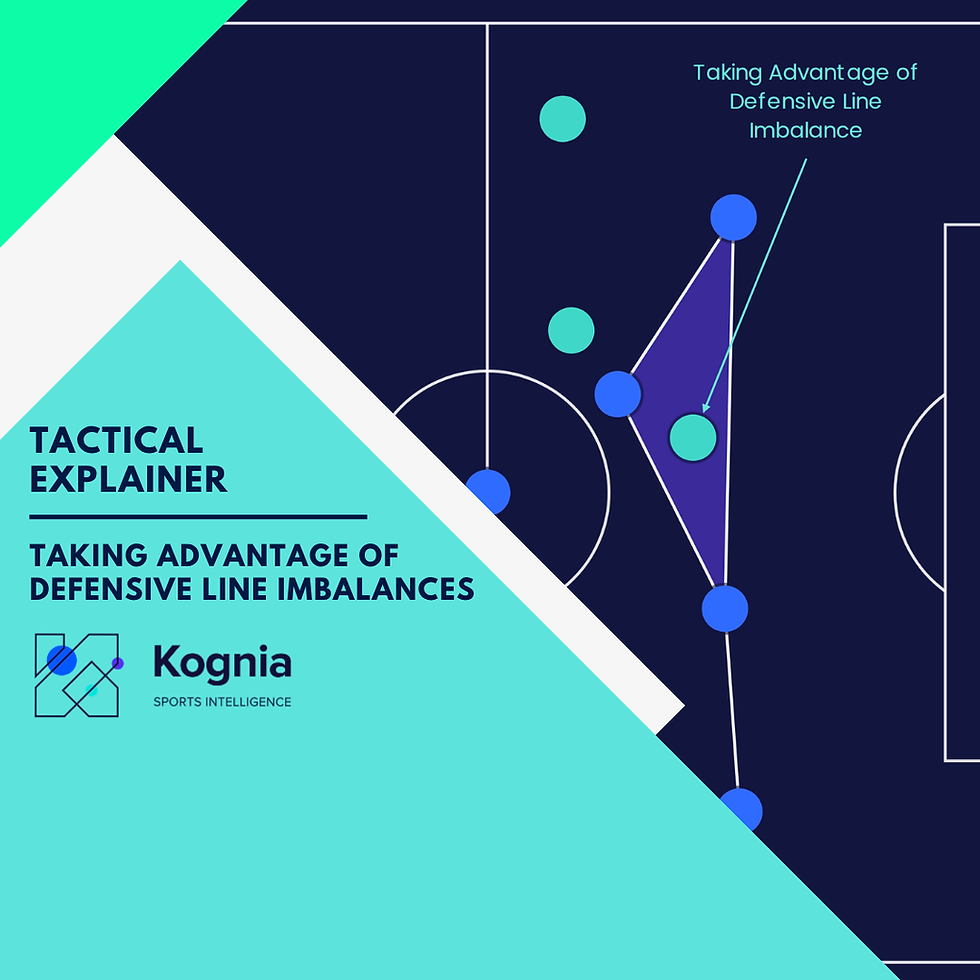
Block 3. Tactical Reading & Anticipation: measures the ability to neutralise defensive line imbalances; reading and correcting numerical or positional advantages the opponent attempts to generate.
Block 4. Individual & Box Defending: four metrics cover this block measuring defending runs behind the defensive line, defending runs into the box, blocking finishing opportunities and marking opponents in the box. Together they provide a complete picture of the centre-back as a last-resort defender.
Block 5. Second Ball: measures ball recovery after direct play actions by the opponent.
Why the weighting is calibrated to FC Barcelona
A universal centre-back ranking has a fundamental problem: there is no such thing as the perfect centre-back in the abstract. The ideal centre-back for Simeone's Atlético de Madrid is not the same as for Flick's FC Barcelona, which is not the same as for Slot's Liverpool. Every system demands different profiles.
That is why we built a weighting specifically calibrated to FC Barcelona. To do so, we first analysed the team's collective profile - which Barça executes at elite percentiles and which are most frequently repeated in their model of play - and from there assigned the relative weight of each block.
Build-up & passing: 35%. The most heavily weighted block. Barça ranks in the 95th–100th percentile in most build-up metrics at competition level.
Ball-Carrying Under Pressure: 20%. Barça's system demands that centre-backs are able to advance with the ball during phases of organised opponent pressure.
Tactical reading & anticipation: 17%. Neutralising imbalances is critical in a team that voluntarily concedes so much depth. Barça press very high and systematically leave space behind. A centre-back who cannot defend those spaces with anticipation and tactical reading is a structural risk.
Second ball: 12%. Relevant in a team with such high possession rates.
Individual & Box Defending: 6%. Barça is one of the teams that concedes the least danger inside their own box thanks to their possession-based control. This dimension carries less relative weight here.
This weighting is deliberately specific to a particular system. The resulting ranking should not be read as a classification of the best centre-backs in the world in absolute terms, but as the answer to a very precise question: who fits best within FC Barcelona's system?
Focusing on Gerard Martín
When we apply this model to Gerard Martín, the numbers are extraordinary.
In build-up, Gerard ranks in the 100th percentile for filtering passes between lines. For vertical passing he is in the 99th percentile. In ball-carrying under pressure, he registers in the 96th percentile for advancing during the opponent's organised pressure; an action that requires not only technical quality but an exceptional level of game-reading and positional courage.
When it comes to defending space, he reaches the 93rd percentile for defending runs behind the defensive line and the 89th percentile for defending runs into the box.
His tactical understanding appears impressive as he ranks in the 95th percentile for neutralising defensive imbalances. In second ball recovery, his 98th percentile makes him one of the most active centre-backs on the continent in that dimension.
The final score under the weighting: 9.38 out of 10.

Collective contribution: Gerard and Pau
Beyond individual performance, we cross-referenced Gerard Martín's and Pau Cubarsí's data with FC Barcelona's collective profile to understand the real weight each carries within the system.
The results are striking. In particular metrics where Barça ranks at the elite level, Gerard and Pau together generate between 32% and 67% of the team's total output. Two outfield players.
The most remarkable single figure: Gerard alone generates 50% of all FC Barcelona's actions of advancing under organised pressure. One player. Half the entire team's output. In one of the most demanding actions of Flick's system.
Pau Cubarsí, for his part, complements that profile almost perfectly. Where Gerard dominates in refined build-up and ball-carrying under pressure, Pau brings greater solidity in individual defending. These two profiles combine to create complementary roles that cover virtually the entire spectrum of what the system demands from its centre backs.


The European Context: Top 20 U23 Centre-Backs
We analysed 20 U23 centre-backs from Europe's top leagues using the same metrics and the same weighting.
The result places Gerard Martín first in the ranking with 9.38 points, followed by Huijsen (Real Madrid, 9.24), Quansah (Bayer Leverkusen, 9.20), Pubill (Atlético Madrid, 9.05) and Ordoñez (Club Brugge, 9.03). Pau Cubarsí occupies ninth place with 8.75 points.
The presence of Pau Cubarsí in ninth place further confirms FC Barcelona have two centre-backs among the top ten in Europe for their own system.


Comments