
Germany’s World Cup striker selection: making the case with Kognia tactical data
- Apr 28
- 5 min read
Updated: May 14
In this article, Kognia’s Vincent Leifholz analyses the striker candidates for the German national team ahead of the upcoming World Cup.
Search for a striker - six weeks to go
As we move closer to this summer’s World Cup, the German national team is still searching for its best form, as demonstrated by the recent narrow victories against Switzerland and Ghana. A major talking point during the recent international matches has focused on the team’s striker options.
Deniz Undav, the Bundesliga’s most prolific German striker, is seen by the national team manager as little more than a super-sub. Despite his goal-scoring threat, he last started a match in 2024. However other candidates for the centre-forward role, whom Julian Nagelsmann prefers to Undav, are not necessarily performing for their clubs - Kai Havertz has been injured for much of this season and had to be substituted again last weekend due to an injury, whilst Nick Woltemade scored his last goal for Newcastle in February, is struggling for minutes, and has more often been deployed in a midfield role. The players still have six weeks to get into shape and the national coach to find his top strike force.
A potential World Cup surprise
In our analysis, we have also included another player who has caught the eye with his performances for both his club and the German Under-21 national team: Nicolo Tresoldi. Following his move from Hannover to Brugge in the summer of 2025, many were initially sceptical, but the striker has impressed in various competitions and has also gained valuable Champions League experience this season. Unlike the other striker candidates, he has remained completely injury-free this season.
Using Kognia tactical data to assess the four striking options
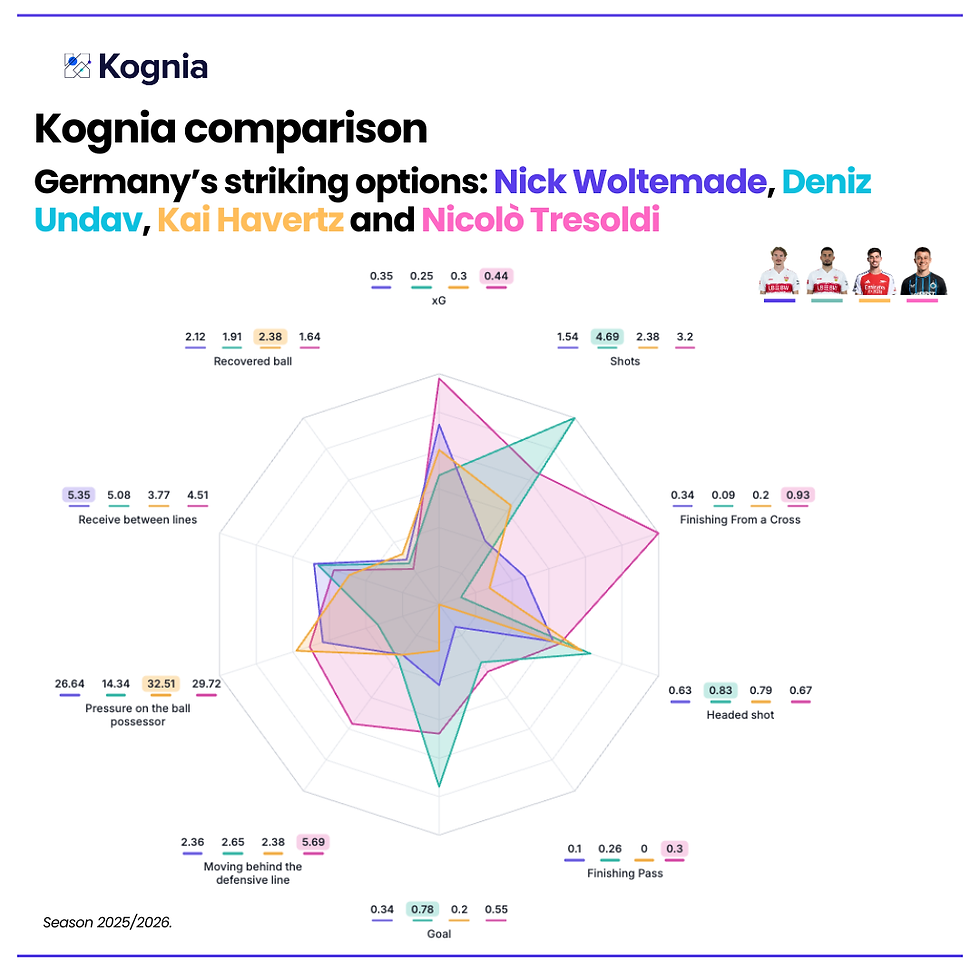
Let’s take a look at the Kognia data, which is specifically designed to analyse striker behaviour, and examine the individual strikers in detail.
Nick Woltemade - a player struggling to find his form
After his move from Stuttgart to Newcastle, he had no trouble settling in at all and scored four goals in his first five league matches. However, he has only managed just four more goals in his subsequent 24 league appearances. In April he played a total of just ten minutes. Woltemade takes the fewest shots per 90 minutes of the four players in the sample and has scored the fewest goals this season after Kai Havertz. Woltemade is a technically gifted and team-oriented striker; of the four candidates, he receives the most passes between the lines. Although he is the player who moves behind the defensive line on the fewest occasions of the four, he stands out in these deep runs for having the highest pace when compared against the three other players. Despite his size, he does not have the best output for shots on goal from crosses and headers.
Kai Havertz - long injury & lack of rhythm
The 2025-26 season got off to anything but a good start for Havertz. After picking up an injury on matchday one against Manchester United, Havertz underwent knee surgery. It wasn’t until late January that he was able to play a full match again, before missing a few more games in February due to muscle problems.
A glance at Havertz’s statistics immediately reveals his work rate off the ball - he applies the most pressure on opponents when they are in possession (pressure on the ball possessor) and, of the four candidates, has the most ball recoveries per 90 minutes.
However, compared to the other candidates, he scores the fewest goals per 90 minutes, has the second-lowest xG value and, after Woltemade, takes the fewest shots. His play on the pitch is characterised by deep runs behind the defensive line and receiving the ball between the lines - this makes him a versatile all-rounder in attack. His deep runs behind the opposition defensive line are the longest of the four candidates, which once again highlights his hard-working playing style. Havertz is not a static player, as emphasised by these longer movements, making him difficult to be marked by opposing defences.
This is also evident when assessing the amount of time players are unmarked in the box, with Havertz recording the longest (3.7 seconds) of the four forwards, which further underlines his game intelligence and ability to stay away from defenders.
Deniz Undav - impressive in attack but under fire for his defensive play
Deniz Undav is the most prolific German player in the Bundesliga this season - he scores the most goals per 90 minutes compared to the other three candidates. He also takes the most shots and heads towards goal most frequently - so he excels in the core skills of a striker. He is a team-oriented striker who likes to operate in the spaces between the lines; after Woltemade, he receives the most balls in these areas. On the other hand, he finishes the fewest chances from crosses and exerts the least pressure on opposing players, which was a notable point of criticism from Nagelsmann.
Nicolo Tresoldi - a rising star but is the World Cup still too soon?
Tresoldi’s statistics stand out. He has the highest xG per 90 , takes by far the most shots following crosses, plays the most key passes leading to a teammate’s shot and makes the most runs in behind the defence (144, with Undav in second place in this ranking with 61 of these movements).
In addition, Tresoldi’s movements in these moments are shorter than the other candidates for the centre forward position, implying that he’s the type of player who plays closer to the last man.
In addition, he is second only to Undav in terms of shots on target and is the second-highest goalscorer after him. Defensively, too, he is the player with the highest intensity after Havertz. Only in the ball recoveries metric does he have the lowest figure, so his high effort rarely pays off.
The Kognia verdict
The absence of Serge Gnabry adds a new level of complexity to the striker line - but there’s no need for a simple either/or decision. A combination of Deniz Undav and Kai Havertz is practically a no-brainer: according to the data. Undav is the most clinical striker in the squad, whilst Havertz provides precisely the defensive agility that Nagelsmann still feels Undav lacks. Particularly in matches where high pressing will be crucial, Woltemade or Tresoldi could be viable options for Undav - whereas in matches where possession is key, Undav’s strengths can be utilised. So the approach can be adapted depending on the opposition. Last but not least Nicolo Tresoldi could become a "super-sub" at the World Cup. With a high xG output, constant runs behind the defensive line and the physical advantage of an injury-free season, he is the ideal weapon off the bench. If a game is deadlocked after the 60th minute, forward-thinking attitude and freshness against tired defenders can make all the difference.


Comments